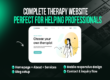

Therapist Website Design: What Actually Makes a Therapy Website Convert
Good therapist website design is not about trends. It is about helping people feel safe enough to take the next step.
When someone lands on a therapist’s website, they are often already carrying stress, confusion, shame, fear, or emotional exhaustion. They are not browsing casually. They are often scanning quickly for signs that this person, this practice, and this process might help them.
That is why therapist websites need a very specific kind of design. They must balance professionalism with warmth, structure with softness, and strategy with human sensitivity.
The purpose of therapist website design
A therapy website has one core job: help the right visitor move from uncertainty to contact.
To do that, the design needs to support three things at once. It needs to create trust, communicate clarity, and reduce resistance.
Many websites fail because they focus only on appearance. But therapist website design needs to go deeper than surface aesthetics. It needs to make it easy for the visitor to understand:
who the therapist helps,
what issues they work with,
how the process works,
what kind of experience the client can expect,
and how to reach out.
When those pieces are missing, even an attractive website can quietly lose inquiries.
First impressions matter fast
Visitors often decide within seconds whether to keep reading.
This means the first screen of your homepage matters a lot. It should quickly show what you do, who it is for, and what action to take next. If the top of the page is vague, cluttered, or too generic, the visitor may leave before they ever get to your stronger content.
Strong therapist website design often starts with a clear headline, a supportive subheadline, and one visible call to action. It does not overwhelm. It orients.
For example, a homepage should not force the visitor to decode what kind of therapist you are. It should make that clear early. Anxiety, trauma, couples work, burnout, grief, self-worth, men’s issues, women’s issues, nervous system work, or relationship struggles should be easy to identify.
Emotional clarity beats overexplaining
Therapists often have deep, nuanced work. But websites need to communicate that depth clearly.
One of the most important parts of therapist website design is turning complex experience into simple, emotionally resonant language. That means your copy should sound human, grounded, and understandable. It should not sound like a textbook or a vague spiritual brochure.
Visitors need enough detail to feel informed, but not so much that they feel overloaded.
This is especially true on the homepage and service pages. Instead of long blocks of abstract theory, the site should help people recognize themselves. Good copy reflects their struggles, names common experiences, and shows the path forward in a way that feels hopeful but realistic.
Design choices influence trust
Colors, spacing, fonts, images, and layout all shape how a therapist is perceived.
A cluttered or outdated website can make a practice feel less trustworthy. A site that is too corporate may feel cold. A site that is too trendy may feel less stable. Good therapist website design finds the right emotional tone for the therapist’s brand and audience.
Usually, this means clean spacing, soft but professional visuals, readable typography, and a mobile-friendly structure. It also means avoiding unnecessary distractions. Too many popups, animations, or mixed messages can make the experience feel chaotic.
Therapy websites work best when they feel calm, intentional, and emotionally coherent.
The role of conversion
A lot of therapists dislike the word conversion because it can sound too sales-driven. But in this context, conversion simply means helping the right person go from interest to contact.
That is why therapist website design should include a clear and supportive inquiry path. Your buttons should be visible. Your contact page should be easy to use. Your consultation offer should be understandable. Your service pages should naturally guide people toward action.
If a visitor feels ready to reach out but the next step is confusing, that is not a marketing problem. It is a usability problem.
SEO and design should work together
Some websites look good but are invisible in search. Others are stuffed with keywords and feel robotic. The best therapist websites do both well.
Search-friendly therapist website design includes clear page structure, relevant headings, optimized titles, thoughtful internal linking, and naturally placed keywords. But it still feels human.
If your site targets terms like therapist website design, trauma therapist website, couples therapist website, or private practice therapist website, those phrases should appear naturally where they make sense. Strong SEO should support clarity, not weaken it.
What makes a therapist website stand out
A standout therapist website does not try to impress everyone. It speaks clearly to the right people.
That means it has a distinct tone, a defined audience, and a strong sense of therapeutic fit. It helps visitors feel, “This might be for me.”
This usually comes from a combination of clear positioning, emotionally intelligent copy, thoughtful structure, and professional design choices that support trust.
Final thoughts
Great therapist website design is not decoration. It is a practical extension of the therapeutic relationship.
It helps people feel seen before they ever write the first email. It lowers hesitation. It increases trust. It makes your work easier to understand and easier to choose.
If your website currently feels too vague, outdated, overwhelming, or weak at bringing inquiries, improving the design is one of the most valuable things you can do for your practice.
Ključne riječi: therapy website, therapy website design, websites for therapists, therapist website design, website design for therapists, therapy practice website, private practice website design, therapist web design, psychotherapy website design, mental health website design